For the next four months (February to May), I’ll be studying abroad with the Budapest Semesters in Mathematics (aka BSM) in Hungary. The first three weeks have been devoted to studying basic Hungarian and learning about Hungarian culture with the Babilon Language School. There are a lot of firsts here: first time in Eastern Europe, first time studying pure math full time, first time eating goulash, etc. I expect this will be a fountain of inspiration for this blog (fingers crossed!), so to avoid having to re-explain the scenario I wanted to preface future posts with this update.
So, without further ado, sziasztok from Budapest!
Tuesday, February 5, 2019

Monday, January 28, 2019
Help Wanted: An Epistemological Concern
I need help. Problems in philosophy are as old as time, and what I'm doing I'm sure is just putting my own personal spin on a conundrum that many, many people have encountered. Nevertheless, I'd love some guidance about how to approach the issue.
I lived in Korea for seven years on Yongsan Garrison, an American military base in the middle of the capital city, Seoul. I graduated from both Seoul American Middle School and Seoul American High School, living, studying, and growing up between the sluggish base and the bright Korean metropolis.
Prior to moving to Seoul, we moved from place to place, spending no longer than 2-3 years in each location. Once we left, we never returned. All I have left of each location I grew up are the memories of those places (and of course, the corroborating accounts of the people in my family who moved with me).
Once I graduated high school, I left Seoul to go to college in New York. As of today, I have spent about three years away from the place where I spent my formative years. With one exception (a one-week reunion with my best friend from high school) I have not had any direct contact with anyone I knew in Korea who isn’t my direct family. The only remnants I’ve seen of my life in Korea are the occasional social media updates that old teachers and students post.
You might be getting some idea about where this story is going. It’s going to take a dramatic turn. The US Military has recently declared that Yongsan Garrison will close in 2019. The place where I did the most growing up is going to be wiped off the face of the map and replaced with a park. Politically speaking, this move was a long time coming. Americans really don’t need to be occupying the most valuable real estate in Korea with a bunch of ugly, outdated military buildings from the 50s.
This is pretty nostalgia-worthy on its own, but more importantly, it got me thinking about the criteria we use to verify our own memories. Let’s say that I have coffee with my friend Matt at Coffee Shop X at time T. A day later, I want to verify that the thing that I remember, this memory I have of drinking coffee with Matt, actually occurred. An obvious thing to do would be to find Matt and see if he has the same memory, and if it accords with mine, then conclude that this is enough evidence for my memory to have happened.
But if the issue at hand is that I want to have some criteria of verifying my own (human) memory, then it doesn’t really make any sense to use someone else’s own (human) memories as evidence for the veracity of mine. The thing that bothers me about this solution is that I’m looking for an independent criterion to verify my own memory, one that doesn’t depend on the memories of others.
So the next obvious thing for me to do is to return to Coffee Shop X. By doing this, I can examine the way the coffee shop looks and smells, its location, the hardness of the tables, even the taste of the coffee I ordered, and if this sensory evidence accords with my memory of coffee yesterday with Matt, then it seems that I have some way of independently establishing some kind of evidence for the veracity of my memories.
It seems to me that at least superficially, something important is to be gained by going back to the location that we remember memories taking place. Which is where my own conundrum comes in:
Going back to the location of my memories of my middle and high schools is unavailable to me. All physical evidence of the base will be gone (well, not entirely: as I understand a museum of the history of the base will be built in the park, but for the purposes of this discussion that doesn’t seem too relevant). If going back to the location of a memory is a good way to independently verify memories, then how can I verify the memories I have of living on base and going to school there for seven years?
To make this more concrete, I want to give a toy example. Let’s say in high school, I hid a pencil somewhere in my school (perhaps in a secret compartment in one of the walls) and didn’t tell anyone about it. Nobody but me knows, and there is not the slightest chance that anyone but me will find the pencil. Once the school is gone, the physical evidence of my hiding the pencil is also gone. The surest way for me to independently find evidence for the truth of my memory (i.e., finding the pencil) is also gone. Is the memory of my hiding the pencil any less legitimate than my memory of making my bed in the morning, which can be easily verified by walking into my room and seeing my bed made?
Whether going back to the location of a memory and examining the physical evidence to verify a memory is enough evidence to judge the veracity of a memory is a good question. In discussions with friends and professors, it seems like a common line of reasoning is that all human experiences that are not occurring at this very moment are memories. Since everything is in flux, and no memory’s setting is exactly the same when we revisit it, no memories can be trusted and so my dramatic case is no different from the ordinary case. Not being able to confirm our memories is just a fact we have to deal with.
But this objection doesn’t negate the central worry: it only provides a degree of graduation. Surely, when we recognize the setting of a memory, it means something. Even if we can’t accept the idea that we can completely verify a memory’s veracity, if the feeling of recognition exists, then being able to go back to the setting of a memory and gaining that bit of evidence provides more certainty than otherwise. So are my memories less legitimate than the memories of someone who can go back to their old school and find the pencil that they hid there?
So, to sum it up, here are the questions I have: what, if any, are good ways to independently verify that memories have occurred? If revisiting the setting of a memory is a good way to do this, then does it follow that my memories of high school are less legitimate than the average high school memory (because I have less of a setting to go back to than others)? Is there then a way for me to “reclaim” my memories? Is there something I’ve missed or haven’t considered thoroughly yet?
I’d love to hear your point of view or perhaps some written sources about this conundrum. It’s difficult to sift through the wealth of epistemological work without some guidance (and I’m sure this problem has been discussed at length many times). Thanks in advance!
I lived in Korea for seven years on Yongsan Garrison, an American military base in the middle of the capital city, Seoul. I graduated from both Seoul American Middle School and Seoul American High School, living, studying, and growing up between the sluggish base and the bright Korean metropolis.
Prior to moving to Seoul, we moved from place to place, spending no longer than 2-3 years in each location. Once we left, we never returned. All I have left of each location I grew up are the memories of those places (and of course, the corroborating accounts of the people in my family who moved with me).
Once I graduated high school, I left Seoul to go to college in New York. As of today, I have spent about three years away from the place where I spent my formative years. With one exception (a one-week reunion with my best friend from high school) I have not had any direct contact with anyone I knew in Korea who isn’t my direct family. The only remnants I’ve seen of my life in Korea are the occasional social media updates that old teachers and students post.
You might be getting some idea about where this story is going. It’s going to take a dramatic turn. The US Military has recently declared that Yongsan Garrison will close in 2019. The place where I did the most growing up is going to be wiped off the face of the map and replaced with a park. Politically speaking, this move was a long time coming. Americans really don’t need to be occupying the most valuable real estate in Korea with a bunch of ugly, outdated military buildings from the 50s.
This is pretty nostalgia-worthy on its own, but more importantly, it got me thinking about the criteria we use to verify our own memories. Let’s say that I have coffee with my friend Matt at Coffee Shop X at time T. A day later, I want to verify that the thing that I remember, this memory I have of drinking coffee with Matt, actually occurred. An obvious thing to do would be to find Matt and see if he has the same memory, and if it accords with mine, then conclude that this is enough evidence for my memory to have happened.
But if the issue at hand is that I want to have some criteria of verifying my own (human) memory, then it doesn’t really make any sense to use someone else’s own (human) memories as evidence for the veracity of mine. The thing that bothers me about this solution is that I’m looking for an independent criterion to verify my own memory, one that doesn’t depend on the memories of others.
So the next obvious thing for me to do is to return to Coffee Shop X. By doing this, I can examine the way the coffee shop looks and smells, its location, the hardness of the tables, even the taste of the coffee I ordered, and if this sensory evidence accords with my memory of coffee yesterday with Matt, then it seems that I have some way of independently establishing some kind of evidence for the veracity of my memories.
It seems to me that at least superficially, something important is to be gained by going back to the location that we remember memories taking place. Which is where my own conundrum comes in:
Going back to the location of my memories of my middle and high schools is unavailable to me. All physical evidence of the base will be gone (well, not entirely: as I understand a museum of the history of the base will be built in the park, but for the purposes of this discussion that doesn’t seem too relevant). If going back to the location of a memory is a good way to independently verify memories, then how can I verify the memories I have of living on base and going to school there for seven years?
To make this more concrete, I want to give a toy example. Let’s say in high school, I hid a pencil somewhere in my school (perhaps in a secret compartment in one of the walls) and didn’t tell anyone about it. Nobody but me knows, and there is not the slightest chance that anyone but me will find the pencil. Once the school is gone, the physical evidence of my hiding the pencil is also gone. The surest way for me to independently find evidence for the truth of my memory (i.e., finding the pencil) is also gone. Is the memory of my hiding the pencil any less legitimate than my memory of making my bed in the morning, which can be easily verified by walking into my room and seeing my bed made?
Whether going back to the location of a memory and examining the physical evidence to verify a memory is enough evidence to judge the veracity of a memory is a good question. In discussions with friends and professors, it seems like a common line of reasoning is that all human experiences that are not occurring at this very moment are memories. Since everything is in flux, and no memory’s setting is exactly the same when we revisit it, no memories can be trusted and so my dramatic case is no different from the ordinary case. Not being able to confirm our memories is just a fact we have to deal with.
But this objection doesn’t negate the central worry: it only provides a degree of graduation. Surely, when we recognize the setting of a memory, it means something. Even if we can’t accept the idea that we can completely verify a memory’s veracity, if the feeling of recognition exists, then being able to go back to the setting of a memory and gaining that bit of evidence provides more certainty than otherwise. So are my memories less legitimate than the memories of someone who can go back to their old school and find the pencil that they hid there?
So, to sum it up, here are the questions I have: what, if any, are good ways to independently verify that memories have occurred? If revisiting the setting of a memory is a good way to do this, then does it follow that my memories of high school are less legitimate than the average high school memory (because I have less of a setting to go back to than others)? Is there then a way for me to “reclaim” my memories? Is there something I’ve missed or haven’t considered thoroughly yet?
I’d love to hear your point of view or perhaps some written sources about this conundrum. It’s difficult to sift through the wealth of epistemological work without some guidance (and I’m sure this problem has been discussed at length many times). Thanks in advance!
Monday, January 21, 2019
The Right Way to Eat Korean Barbecue
Or: Life Lessons from a Bunch of Tasty Meat
Korean barbecue is a phenomenon that has thankfully become a phenomenon in the States, which is fortunate because I was not about to give up my grilled meat when I came back the States. During the seven years I lived in Seoul, Korean barbecue happened at least once every two months or so (whenever my Korean grandfather came to visit, for instance, which was often).
Oh, the gluttonous joy that came from these meals. Koreans are experts at stuffing themselves, and a typical KBBQ experience entailed stuffing myself with enough meat, rice, and side dishes to explode… and then finishing the evening with one or two more gut-busting noodle and soup courses before sprawling on the floor and stacking the mats as pillows to snooze off the calories (the only reason this was okay was because I was pretty young- not recommended for general audiences). We did this often, and we went hard. It’s a total Korean experience, the full package.
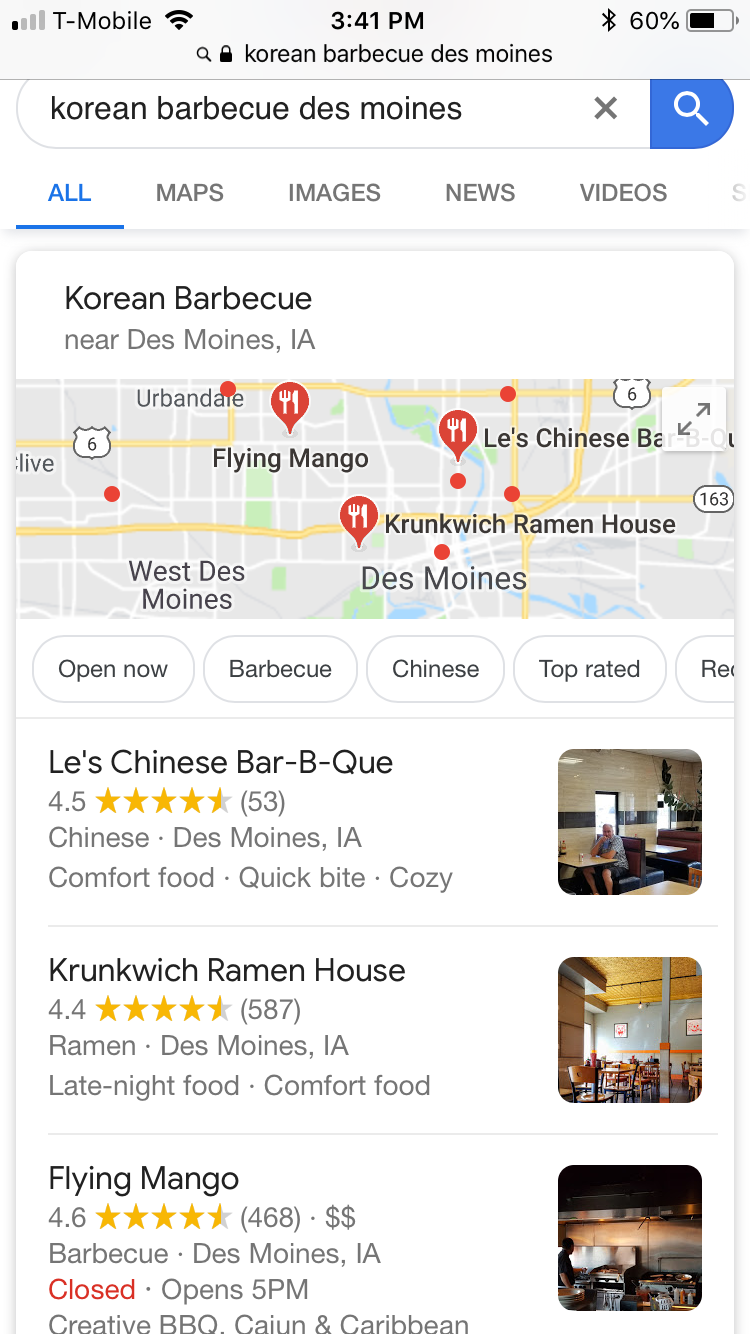
Anyway, I was talking to a poor soul from rural Iowa and who insisted that there is no such thing as Korean barbecue there. Skeptic that I am, I googled Korean barbecue places in Des Moines, and unfortunately, this is what came up:
I kind of wanted to laugh when I saw that the top result was “Le’s Chinese Bar-B-Que” but instead I kind of died a little on the inside instead. Iowans, this is a significant market opportunity! Bring KBBQ to Iowa!
So this conversation led me to believe that there exists a non-trivial cohort of Americans who have never had the true KBBQ experience. There are a number of “guides” for eating Korean barbecue online, but for the most part these are just descriptions of what’s going to come out, with very few if any practical guides for how to enjoy the food the most. Far and away the best thing I found at KimchiTiger (which by the way is an awesome blog with content I can really get behind) here: https://kimchitiger.com/blogs/all/18063299-how-to-eat-korean-bbq-like-a-korean.
The article is great, but there are a few finer points I think it misses. First of all, most KBBQ tips advise getting samgyupsal (pork belly) or kalbi (marinated short rib), both of which are delicious and worth trying. But it’s also worth noting that samgyupsal tends to be one of the cheapest options, while kalbi is going to be one of the more expensive things on the menu.
Also, nobody seems to talk enough about dyejigalbi (marinated pork ribs) enough! When we lived in Korea, it was the only thing we ordered when we went out for barbecue. It’s all the tender deliciousness of marinated meat that you get with beef, minus some of the expense. Also sometimes I’m just not feeling the greasy pork belly feeling.
The other thing I love about the KimchiTiger article is it actually shows you how to use ssam to make your little lettuce package of joy, which is something so Korean that all your Korean friends will be shocked if you do it out of the box (assuming you’re not Korean, of course).
But the personal beef (heh) that I’m going to bring up is that the major mistake people make when they eat Korean barbecue is to assume there’s a right way to eat Korean barbecue. Aha, the clever ruse of the title has been exposed!
I don’t know, maybe when you’re eating a filet mignon it’s not really proper to chop it into little pieces and mix it with the salad or something. But the best way to approach Korean barbecue—and Korean food in general—is to take advantage of the extraordinary wealth of options that come in the form of all these delicious side dishes and accompaniments and really experiment to find something delicious.
Try eating a piece of meat with just the marinated onions. Then try doing that plus a piece of kimchi, or maybe a spoonful of buckwheat noodles (nengmyun). Or maybe you’ll dip it in ssam-jang and sample with a sesame leaf, or eat it with a piece of tofu, or maybe you’ll put five different side dishes and three pieces of meat on a lettuce leaf (which you must eat whole—no bites).
My point is, there are really no wrong answers. Probably the worst thing you could do while eating Korean barbecue is to assume there is a right answer and deprive yourself of the opportunity of mixing and matching so many different flavors and textures. (who knew such a delicious medium could be a metaphor for life?)
And if at the end of the day the mixing and matching doesn’t do it for you, then by all means feel free to revert back to dipping the meat in salt/oil and eating it with rice (just know that people like me who live for flavor combinations will definitely judge you for this).
Just don’t do anything too weird, like eating your chopsticks, and if you find a flavor combination that is delicious then I’m sure your table companions will applaud you.
Sunday, December 16, 2018
The Number Three: A Metaphysical Mystery
When George Simpson opened his eyes from unsettling dreams, he found himself changed into the number three.
In fact, not all instances of the number three, but this one in particular: 3.
There he is.
George is static, stuck between a colon and a period. His three-ness does not particularly bother him—in fact, it is perhaps immensely more relaxing than being a human. All of his worries as a human seem far distant.
But he’s not unaware of the immense responsibilities that come with representing the number three. George doesn’t know if he’s imagining it, but he feels a profound connection with all instances of the number three, from the few times it’s been mentioned in this very manuscript to the instance where, just now, I said the number “three.” He represents a long and storied legacy that began almost as soon as humans developed the capacity to hold up fingers and think.
He wonders whether his family will be concerned now that he is a number. Or for that matter, how will they know that he is a number? Even if they somehow find out that he has become the number three in this manuscript, how will they know which number three he is?
Of course, we know which one he is. He is the number three expressed only a few paragraphs ago.
George has decided that though it is concerning that his family and friends will have no idea that he has become the number three, he has deeper issues to contend with: the entire situation reminds him of a scenario from his favorite book, in which the protagonist turns into a cockroach. George has wondered all his life whether such a thing would be possible, and now that he is the number three he supposes that it must, indeed, be so.
George laughs to think that anyone could doubt that becoming a cockroach is possible when he himself has been transformed into a number.
He is not so concerned with the how or why, but more deeply troubled by the what.
What is he, now that he is the number three? He can feel his three-ness, but being three is not the same as being a human. He used to feel and stretch his limbs, he would drink water when he was thirsty and sleep long into the mornings. He wouldn’t say there is anything physical to his being now. He can no longer feel his own “body.” Threes don’t have eyes to see, or skin to touch. But yet he exists!
And yet another issue: by what mechanism does he think? Surely threes have no brains, so where is the container of the mind? George is not sure what to make of the fact that at this very moment he is contemplating his existence, and yet has no way of verifying any mechanism for that existence. He finds the situation vaguely spooky, if not outright alarming.
George has thought about these issues for a while but has decided that it is probably not so concerning after all. Now that he is the number three, it is not really within his nature to wonder about such fundamental problems. George is content to just continue being the number three.
But wait— George remembers something similar happening to the protagonist in the cockroach story. After being a cockroach for a while, the protagonist embraced his cockroach-ness and slowly forgot who he was, losing his very humanity. George can’t be sure quite yet, but he doesn’t think he’ll forget his humanity—there’s no reason to, now that the unreliable firings of his bygone neurons have no chance to misfire or wither away or misalign. If George loses his humanity, he decides, then it is by his own design.
The real question here, George thinks, is whether or not he can trust his memories. He remembers being human, but now he is the number three. Where can he go, what can he do to verify those memories? There’s no way for him to return to the places he’s been and compare the images in his head with the real world, so how can he know that being human wasn’t some elaborate dream that he, a lowly three, just made up? Try as he might, George can’t imagine any good criteria to judge the truthfulness or trustworthiness of his memories—he only knows that the memories exist, and don’t change (again—no brain to change the memories, so they remain immutable).
Oh dear! Poor George, thinking so hard about his three-ness, has rendered his very existence into a hazy misremembered kind of dream, and can’t even clearly articulate where he ends and the other mundane, lifeless letters and numbers and punctuation marks begin. George almost regrets the amount of thought he’s put into these matters, but then stops to laugh at his own worries—if his own existence and identity bother him so much, then evidently, his humanity isn’t so gone after all!
In fact, not all instances of the number three, but this one in particular: 3.
There he is.
George is static, stuck between a colon and a period. His three-ness does not particularly bother him—in fact, it is perhaps immensely more relaxing than being a human. All of his worries as a human seem far distant.
But he’s not unaware of the immense responsibilities that come with representing the number three. George doesn’t know if he’s imagining it, but he feels a profound connection with all instances of the number three, from the few times it’s been mentioned in this very manuscript to the instance where, just now, I said the number “three.” He represents a long and storied legacy that began almost as soon as humans developed the capacity to hold up fingers and think.
He wonders whether his family will be concerned now that he is a number. Or for that matter, how will they know that he is a number? Even if they somehow find out that he has become the number three in this manuscript, how will they know which number three he is?
Of course, we know which one he is. He is the number three expressed only a few paragraphs ago.
George has decided that though it is concerning that his family and friends will have no idea that he has become the number three, he has deeper issues to contend with: the entire situation reminds him of a scenario from his favorite book, in which the protagonist turns into a cockroach. George has wondered all his life whether such a thing would be possible, and now that he is the number three he supposes that it must, indeed, be so.
George laughs to think that anyone could doubt that becoming a cockroach is possible when he himself has been transformed into a number.
He is not so concerned with the how or why, but more deeply troubled by the what.
What is he, now that he is the number three? He can feel his three-ness, but being three is not the same as being a human. He used to feel and stretch his limbs, he would drink water when he was thirsty and sleep long into the mornings. He wouldn’t say there is anything physical to his being now. He can no longer feel his own “body.” Threes don’t have eyes to see, or skin to touch. But yet he exists!
And yet another issue: by what mechanism does he think? Surely threes have no brains, so where is the container of the mind? George is not sure what to make of the fact that at this very moment he is contemplating his existence, and yet has no way of verifying any mechanism for that existence. He finds the situation vaguely spooky, if not outright alarming.
George has thought about these issues for a while but has decided that it is probably not so concerning after all. Now that he is the number three, it is not really within his nature to wonder about such fundamental problems. George is content to just continue being the number three.
But wait— George remembers something similar happening to the protagonist in the cockroach story. After being a cockroach for a while, the protagonist embraced his cockroach-ness and slowly forgot who he was, losing his very humanity. George can’t be sure quite yet, but he doesn’t think he’ll forget his humanity—there’s no reason to, now that the unreliable firings of his bygone neurons have no chance to misfire or wither away or misalign. If George loses his humanity, he decides, then it is by his own design.
The real question here, George thinks, is whether or not he can trust his memories. He remembers being human, but now he is the number three. Where can he go, what can he do to verify those memories? There’s no way for him to return to the places he’s been and compare the images in his head with the real world, so how can he know that being human wasn’t some elaborate dream that he, a lowly three, just made up? Try as he might, George can’t imagine any good criteria to judge the truthfulness or trustworthiness of his memories—he only knows that the memories exist, and don’t change (again—no brain to change the memories, so they remain immutable).
Oh dear! Poor George, thinking so hard about his three-ness, has rendered his very existence into a hazy misremembered kind of dream, and can’t even clearly articulate where he ends and the other mundane, lifeless letters and numbers and punctuation marks begin. George almost regrets the amount of thought he’s put into these matters, but then stops to laugh at his own worries—if his own existence and identity bother him so much, then evidently, his humanity isn’t so gone after all!
Tuesday, July 10, 2018
The God Complex
The pressure of a college math exam manifests (at least, for me) in sweaty palms, a racing heartbeat, tunnel vision—no matter how many hours I’ve studied, no matter how well I think I know the material, when I see the ten pages of five problems (my grade in the class hinging on my ability to solve them in a little over one hundred minutes) I have to fight down the panic rising from my chest.
I’m convinced that one of the biggest secrets to doing well on tests like these (and in other high pressure scenarios—for example, job interviews, speeches, etc.) is the ability to act like—or know that—the task at hand is a piece of cake. This confidence bordering on arrogance allows the best students to plunge headlong into a math test where we all know the average will be a straight up 30% allows them to attack the problems, despite the fact that they (as well as the rest of the class) will fail to answer most of them correctly.
I’ve done the best on tests where I was able to channel this confidence into steadying my hand and clearing my head. I made fewer mistakes, didn’t second-guess myself into the wrong answer. Convincing myself that I was going to do well was half the battle in actually doing well—and the other half was the hard work I had spent preparing myself beforehand.
It’s a funny thing, this confidence-arrogance. This fall, when I interviewed for a glitzy finance internship despite the fact that I hardly knew what a bond was, I mercilessly quashed my more natural self-doubt and strode into the interview with as much self-assuredness as I could muster. Instead of trying to balance humility and confidence, I threw caution to the winds and, at least to my ears, sounded like an arrogant prick. My overcompensation was rewarded—evidently, what I thought was arrogance was to my interviewers a nice healthy dose of confidence.
It wasn’t until I was describing this strange phenomenon to my dad, walking around the lake near our house in the muggy summer heat, that he finally put a name to this phenomenon: a God Complex.
Having a God Complex isn’t a great thing. Here’s what Urban Dictionary says: “A psychosis based in uncontrolled narcissism, inflated arrogance and a perceived need to subjugate and/or ridicule other individuals deemed to be inferior or unworthy.” People with God Complexes are said to be psychopaths.
But in high pressure scenarios, particularly if it’s general knowledge that the outcome will be bad for most people, the God Complex is an indispensable asset—at least, in a milder form.
At this point, it’s difficult not to gender the issue. I first observed the usefulness of the Mild God Complex in a setting that is inherently gender biased—the math major is heavily skewed towards males, as are most STEM majors at universities. I’ve walked into math society meetings and math prize exams—rooms actually filled with major students—where I am one of only two or three women. I can’t help but think that this Mild God Complex, this confidence-arrogance—is a trait that, like having a deeper voice or bigger physiques, gives men in general the edge in high-pressure scenarios like math exams or finance interviews.
Statements like this warrant more thorough research, but it seems that in general women are more likely to be the ones who doubt their own abilities, or temper their confidence with self-doubt. I know that at least for me, striving towards having a Mild God Complex has helped me through scenarios where my own lack of confidence would have been detrimental.
There is always the question about how much is too much, but what I’ve noticed is that I’ve still got a long way to go before I have to worry about being too arrogant—my brain is so hardwired towards self-deprecation that it takes all the God Complex I can muster to let go of that doubt.
Like most things, a work in progress.
I’m convinced that one of the biggest secrets to doing well on tests like these (and in other high pressure scenarios—for example, job interviews, speeches, etc.) is the ability to act like—or know that—the task at hand is a piece of cake. This confidence bordering on arrogance allows the best students to plunge headlong into a math test where we all know the average will be a straight up 30% allows them to attack the problems, despite the fact that they (as well as the rest of the class) will fail to answer most of them correctly.
I’ve done the best on tests where I was able to channel this confidence into steadying my hand and clearing my head. I made fewer mistakes, didn’t second-guess myself into the wrong answer. Convincing myself that I was going to do well was half the battle in actually doing well—and the other half was the hard work I had spent preparing myself beforehand.
It’s a funny thing, this confidence-arrogance. This fall, when I interviewed for a glitzy finance internship despite the fact that I hardly knew what a bond was, I mercilessly quashed my more natural self-doubt and strode into the interview with as much self-assuredness as I could muster. Instead of trying to balance humility and confidence, I threw caution to the winds and, at least to my ears, sounded like an arrogant prick. My overcompensation was rewarded—evidently, what I thought was arrogance was to my interviewers a nice healthy dose of confidence.
It wasn’t until I was describing this strange phenomenon to my dad, walking around the lake near our house in the muggy summer heat, that he finally put a name to this phenomenon: a God Complex.
Having a God Complex isn’t a great thing. Here’s what Urban Dictionary says: “A psychosis based in uncontrolled narcissism, inflated arrogance and a perceived need to subjugate and/or ridicule other individuals deemed to be inferior or unworthy.” People with God Complexes are said to be psychopaths.
But in high pressure scenarios, particularly if it’s general knowledge that the outcome will be bad for most people, the God Complex is an indispensable asset—at least, in a milder form.
At this point, it’s difficult not to gender the issue. I first observed the usefulness of the Mild God Complex in a setting that is inherently gender biased—the math major is heavily skewed towards males, as are most STEM majors at universities. I’ve walked into math society meetings and math prize exams—rooms actually filled with major students—where I am one of only two or three women. I can’t help but think that this Mild God Complex, this confidence-arrogance—is a trait that, like having a deeper voice or bigger physiques, gives men in general the edge in high-pressure scenarios like math exams or finance interviews.
Statements like this warrant more thorough research, but it seems that in general women are more likely to be the ones who doubt their own abilities, or temper their confidence with self-doubt. I know that at least for me, striving towards having a Mild God Complex has helped me through scenarios where my own lack of confidence would have been detrimental.
There is always the question about how much is too much, but what I’ve noticed is that I’ve still got a long way to go before I have to worry about being too arrogant—my brain is so hardwired towards self-deprecation that it takes all the God Complex I can muster to let go of that doubt.
Like most things, a work in progress.
Monday, April 9, 2018
Regalo
Tarragona in March is chilly. Luckily, the day was bright and the sun glittered on the turquoise water. The Roman ruins dotted across town look over the coast, and a few locals took in the early spring sunshine in fragrant parks next to the amphitheater or on the breezy beach. Hungry from traipsing around the empty stone ruins, we ventured into the town, down a rough-and-tumble road, stopping at the first deli-café hybrid we stumbled across--
A hole in the wall, with a menu written only outside and featuring hamburgers, platos, sandwiches. The three of us ordered bocadillos with jamón. The friendly café owner had kind eyes, and the place was empty save one other person sipping café con leche and reading the paper. He brought out our bocadillos, spread with tangy tomato sauce on crispy baguettes. Jenny had ordered a café con leche, delicious with the baguette. It was too late in the day for caffeine, but I was trying to pin down a craving.
“How much would a cup of milk cost?” I asked in meager Spanish. The owner smiled— “Don’t worry. Un regalo.” A present. In that tiny café in Tarragona, Spain, I enjoyed warm, creamy milk with my bocadillo.
Arguably it was just a cup of milk. What about the regalo made it so special?
Regalo—faithful Google says it comes from the old French word for “galer” or “to make merry, to amuse, to rejoice” Etymologically speaking, a regalo is at its heart something that makes us happy. Our English word “gallant” comes from the same root, apt when the verb became the adjective for “bold or amusing one.”
In English, the word “gift” or “present” implies a special occasion. It tastes like frosting and ice cream, sounds like the crinkle of wrapping paper on a snowy morning. Gifts are surprises from those that care about you, or maybe quid pro quo for the invitation. Gifts happen sparingly, so sparingly that I was euphoric when my mind automatically translated the café owner’s “regalo”—it was my lucky day!
An English speaker would have used some sort of idiom—like “on the house”—to describe the free milk. Perhaps Spanish speakers see the word “regalo” as the same, and my English-wired brain perceives the use of that particular word as something special merely because of the way that standard English-Spanish dictionaries translate it. Maybe I’m ascribing English nuances to Spanish words.
But wouldn’t it be a nice thought if “regalo” is used because of its special connotations? That is, we can find small regalos in everyday life, things that we don’t have to wait once or twice a year for, that can make us incontrovertibly happy? We don’t have to spend a lot of money or take a lot of time to give a regalo that will brighten someone’s day. If a shop owner with kind eyes can, in a single moment, simply hand a complete stranger (and tourist, to boot) a cup of milk as a regalo, what’s to stop any of us from giving simple regalos away?
Regalos don’t have to be complex, or beautiful. They can be simple and spontaneous, bringing nothing but happiness to the receiver.
Sources: https://www.etymonline.com/word/gallant
https://spanishetymology.com/regalo-and-gala-gallant/
https://en.wiktionary.org/wiki/regalar
A hole in the wall, with a menu written only outside and featuring hamburgers, platos, sandwiches. The three of us ordered bocadillos with jamón. The friendly café owner had kind eyes, and the place was empty save one other person sipping café con leche and reading the paper. He brought out our bocadillos, spread with tangy tomato sauce on crispy baguettes. Jenny had ordered a café con leche, delicious with the baguette. It was too late in the day for caffeine, but I was trying to pin down a craving.
“How much would a cup of milk cost?” I asked in meager Spanish. The owner smiled— “Don’t worry. Un regalo.” A present. In that tiny café in Tarragona, Spain, I enjoyed warm, creamy milk with my bocadillo.
Arguably it was just a cup of milk. What about the regalo made it so special?
Regalo—faithful Google says it comes from the old French word for “galer” or “to make merry, to amuse, to rejoice” Etymologically speaking, a regalo is at its heart something that makes us happy. Our English word “gallant” comes from the same root, apt when the verb became the adjective for “bold or amusing one.”
In English, the word “gift” or “present” implies a special occasion. It tastes like frosting and ice cream, sounds like the crinkle of wrapping paper on a snowy morning. Gifts are surprises from those that care about you, or maybe quid pro quo for the invitation. Gifts happen sparingly, so sparingly that I was euphoric when my mind automatically translated the café owner’s “regalo”—it was my lucky day!
An English speaker would have used some sort of idiom—like “on the house”—to describe the free milk. Perhaps Spanish speakers see the word “regalo” as the same, and my English-wired brain perceives the use of that particular word as something special merely because of the way that standard English-Spanish dictionaries translate it. Maybe I’m ascribing English nuances to Spanish words.
But wouldn’t it be a nice thought if “regalo” is used because of its special connotations? That is, we can find small regalos in everyday life, things that we don’t have to wait once or twice a year for, that can make us incontrovertibly happy? We don’t have to spend a lot of money or take a lot of time to give a regalo that will brighten someone’s day. If a shop owner with kind eyes can, in a single moment, simply hand a complete stranger (and tourist, to boot) a cup of milk as a regalo, what’s to stop any of us from giving simple regalos away?
Regalos don’t have to be complex, or beautiful. They can be simple and spontaneous, bringing nothing but happiness to the receiver.
Sources: https://www.etymonline.com/word/gallant
https://spanishetymology.com/regalo-and-gala-gallant/
https://en.wiktionary.org/wiki/regalar
Monday, April 2, 2018
The Price of Vanity
My mother’s catchphrase is “beauty is pain.” Implicit in the motto is that beauty is (obviously) worth the pain. For her, a woman who grew up deprived of both male companionship and the joys of female preening (she sported a bowl cut in an all-girls’ school for eleven years), the acts of plucking, polishing, blending, lining—are all part of the regular maintenance of a woman. In a word, like keeping your car washed or your lawn trimmed.
And my mother is beautiful. The day of bowl cuts and baggy clothes are long gone. Like a fine wine, she’s grown sweet and oaky. Growing up, I was often confused for her sister. If I were her sister, then I was the gawky one next to her flawless face and trim body.
She, however, always insisted I was beautiful. In the classically Korean modus operandi, all of our family and friends agree. I’ve been called pretty for as long as I can remember, my height grounds for becoming the next “Miss America,” for as long as I’ve been in the 99th percentile.
There is a subtlety at play here: you can be told you are beautiful as much as you like. But it will never improve your self esteem unless you actually believe it. The trap is this: you refuse to believe such a thing, partly because society has told you this is unacceptable, but mostly because you know that if you do, you will become the world’s most insufferable pretentious bitch.
But, paradoxically, if you don’t make peace with your own inner or outer beauty, every time you hear the words “how pretty!” they will do nothing but fuel your vanity.
Key point: low self-esteem and vanity are not mutually incompatible. In fact, they downright fuel each other.
Vanity, unlike self-confidence, is needing to be the prettiest person in the room because you were told that you are. Vanity is looking in the mirror too much because you are afraid you won’t be the prettiest. Truly self-confident people don’t need to look—they are self-assured enough to know that whatever some reflective surface might say, they’ll retain their intrinsic beauty and worth.
What I inherited from my mother and everyone else who had a nice thing to say about my looks is not self-confidence, but a fundamental sense of vanity fueled by my own lack of self-worth.
Beauty is not pain. The vanity that comes from “beauty” is pain.
What are the immediate consequences? Let’s talk about one obvious one: love. If you are self-confident, similarly self-confident people will be attracted to your aura. No matter what you look like physically, you’ll glow with assurance.
If you’re vain, you will attract everyone who looks with their eyes. The price of vanity is love. What I get in return for exchanging the potential to love somebody good, and true, is my constant judgment of everyone who doesn’t maintain themselves as well as I think they should. People look at me with their eyes, but I look back just as much, with standards that are not only unrealistic, but harmful to everyone I impose them on.
Thus, love and vanity are mutually incompatible. The tired old idiom is true. If you can’t see your own inner beauty, how could you possibly see that in others? Vanity is the poison that stops us not only from loving ourselves, but also from loving others.
I’ve been working on curbing my vanity. Walking on my street, my head flicks towards any reflective surface—like an owl spotting a vole. Nowadays I try as best as I can to turn away from those reflective car mirrors, resisting the urge to critique my figure in every glass door I pass. These are small steps. There is still much work to be done.
But I’m grateful for having taken the first step: realizing the price of vanity, and, more importantly, that it’s not a price I’m willing to pay anymore.
And my mother is beautiful. The day of bowl cuts and baggy clothes are long gone. Like a fine wine, she’s grown sweet and oaky. Growing up, I was often confused for her sister. If I were her sister, then I was the gawky one next to her flawless face and trim body.
She, however, always insisted I was beautiful. In the classically Korean modus operandi, all of our family and friends agree. I’ve been called pretty for as long as I can remember, my height grounds for becoming the next “Miss America,” for as long as I’ve been in the 99th percentile.
There is a subtlety at play here: you can be told you are beautiful as much as you like. But it will never improve your self esteem unless you actually believe it. The trap is this: you refuse to believe such a thing, partly because society has told you this is unacceptable, but mostly because you know that if you do, you will become the world’s most insufferable pretentious bitch.
But, paradoxically, if you don’t make peace with your own inner or outer beauty, every time you hear the words “how pretty!” they will do nothing but fuel your vanity.
Key point: low self-esteem and vanity are not mutually incompatible. In fact, they downright fuel each other.
Vanity, unlike self-confidence, is needing to be the prettiest person in the room because you were told that you are. Vanity is looking in the mirror too much because you are afraid you won’t be the prettiest. Truly self-confident people don’t need to look—they are self-assured enough to know that whatever some reflective surface might say, they’ll retain their intrinsic beauty and worth.
What I inherited from my mother and everyone else who had a nice thing to say about my looks is not self-confidence, but a fundamental sense of vanity fueled by my own lack of self-worth.
Beauty is not pain. The vanity that comes from “beauty” is pain.
What are the immediate consequences? Let’s talk about one obvious one: love. If you are self-confident, similarly self-confident people will be attracted to your aura. No matter what you look like physically, you’ll glow with assurance.
If you’re vain, you will attract everyone who looks with their eyes. The price of vanity is love. What I get in return for exchanging the potential to love somebody good, and true, is my constant judgment of everyone who doesn’t maintain themselves as well as I think they should. People look at me with their eyes, but I look back just as much, with standards that are not only unrealistic, but harmful to everyone I impose them on.
Thus, love and vanity are mutually incompatible. The tired old idiom is true. If you can’t see your own inner beauty, how could you possibly see that in others? Vanity is the poison that stops us not only from loving ourselves, but also from loving others.
I’ve been working on curbing my vanity. Walking on my street, my head flicks towards any reflective surface—like an owl spotting a vole. Nowadays I try as best as I can to turn away from those reflective car mirrors, resisting the urge to critique my figure in every glass door I pass. These are small steps. There is still much work to be done.
But I’m grateful for having taken the first step: realizing the price of vanity, and, more importantly, that it’s not a price I’m willing to pay anymore.
Subscribe to:
Posts (Atom)